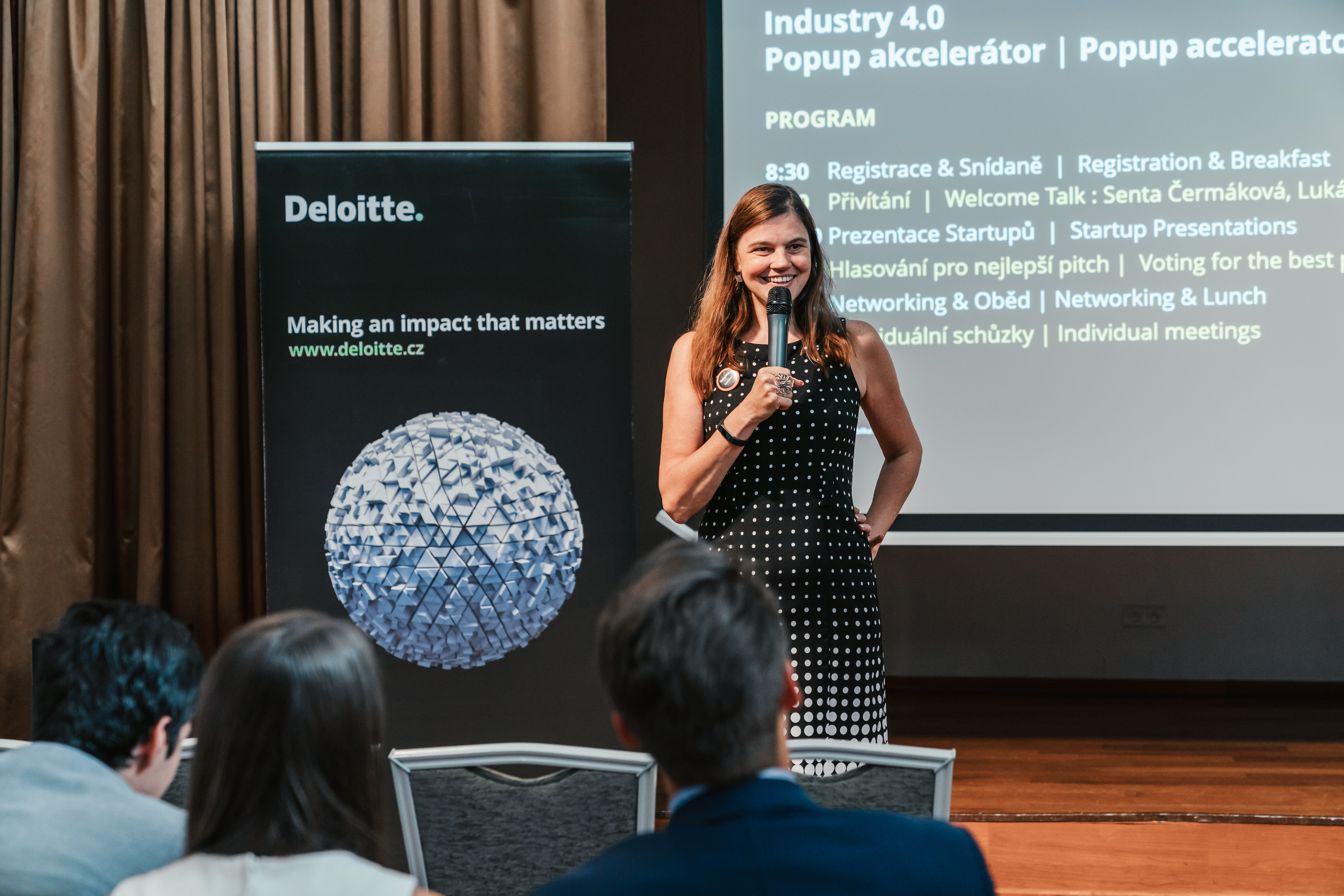
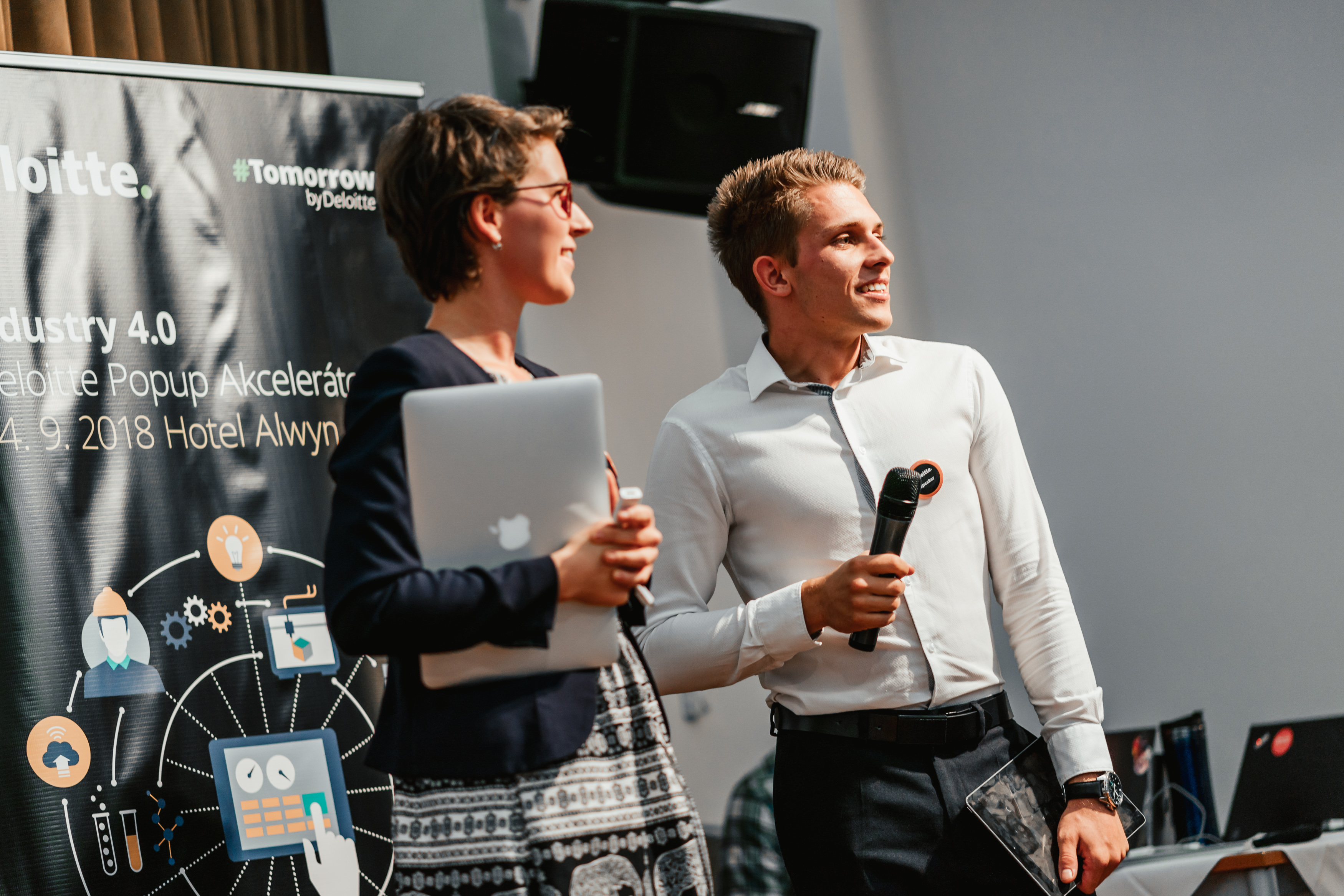
Industry 4.0 – this is the key term of the last few years. How can we integrate cyber-physical systems in production processes in factories and what advantages do these smart instruments bring? Read the report on the latest Deloitte popup accelerator that focused on the topic of Industry 4.0.
The common denominator of the September accelerator was digitalisations. Smart solutions from the area of predictive maintenance, logistics, supply chain optimisation or production streamlining were presented by the representatives of five start-ups. Each of them had seven minutes to familiarise the public with their product, its functioning, benefits and competitive advantages. The attendees then used an application to decide which startup convinced them the most.
Popup accelerator focused on Industry 4.0
“Collecting data is not enough. It is important to process them and be able to transmit them to employees in a way that everyone can understand,” says Plantyst, a company offering software for increasing the efficiency of production processes. The solution includes not just the monitoring of the running and production of all machinery involved in manufacturing, but it also allows creating clear reports that enable employees to quickly obtain information about the efficiency of work in the individual shifts.
Most people put smartphones away when they get to work. The startup B2A wants to change that and brings various types of applications for optimising the production process. The applications include “Pracoviště” (Workplace), “Mistr” (Foreman) or “Sklad” (Warehouse), which are supplied to clients together with iPads where they are already installed. For example, the app “Fronta práce” (Work queue) shows workers the time of starting work on a particular work task, the time of anticipated termination, what tools will be necessary and the so-called timeline – history, who did what and when with respect to the respective work task.
Increase in efficiency and optimisation of the production process is also the goal of the application produced by Factorify. Its primary benefit is capacity planning consisting in immediate recalculation of the production plan based on the current situation. For example, the application takes into account which people are at work and when, who will be on vacation and when, when material will be available and what tools each specific worker will need.
If something breaks down inside a machine, you can hear it. Experienced mechanics can even tell based on the sound the machine makes what sort of breakdown it is. The startup Neuron soundware decided to teach this this skill to its product. At present, this company therefore offers a technology running on the basis of neuron networks that can use a sound analysis not only to diagnose a malfunction of a machine directly in a plant, but also to predict such a malfunction. Neuron soundware has recently successfully begun to break into foreign markets.
Predictive maintenance is also one of the functions that are offered as part of the product of the only foreign startup participating in this popup accelerator, Relimetrics. However, it does not operate on an auditory basis as the above project, but visual, thanks to the monitoring of production equipment in real time using an industrial camera. The software offered by the German company then ensures the optimisation of quality audit, digitalisation of the visual product check or process management in production. Based on the information of the company, the software increases the clients’ productivity by 50 to 80 percent.
And who attracted the most interest? The first place went to Neuron soundware, which won the participation at a Deloitte Private strategic workshop. Congratulations!