Sustainability
The revised ESRS are finally official. What has changed since last year’s draft?
In last year’s article, Draft ESRS 2025: Simplification and New Challenges, we outlined the general direction of the then forthcoming revision of the European Sustainability Reporting Standards (ESRS). We now have the final legal text: Commission Delegated Regulation (EU) 2026/1563 was published in the Official Journal of the European Union on 21 September 2026. The simplified ESRS continue to emphasise the materiality of information, a substantial reduction in datapoints, simplified treatment of the value chain and closer alignment with international frameworks. The revised ESRS will enter into force on 10 November 2026 and will be mandatory for financial years beginning on or after 1 January 2027.
What is changing compared with the original 2023 ESRS?
| Area |
Original ESRS |
Revised ESRS |
| Scope of requirements |
An extensive set of mandatory and voluntary provisions. |
Mandatory datapoints have been reduced by more than 60%, and the total number of datapoints by more than 70%. Voluntary “may disclose” provisions have been removed. |
| Double materiality |
In practice, the assessment was often highly detailed and bottom-up. |
A top-down approach is explicitly supported. If materiality is not evident, a targeted assessment of the specific impacts, risks and opportunities follows. |
| Fair presentation |
The principal filter was the materiality of the information disclosed. |
The sustainability statement, taken as a whole, must achieve fair presentation; materiality remains the principal information filter. |
| Structure of the sustainability statement |
The structure was more prescriptive, and the Application Requirements were set out in appendices. |
Greater flexibility in presentation, the option to include a concise executive summary and, subject to the conditions in the standard, the option to depart from the prescribed structure. |
| Value chain |
Greater emphasis on obtaining primary data. |
Greater use of reasonable and supportable information available without undue cost or effort, together with new targeted reliefs. |
What has changed compared with the previous draft?
The core approach of EFRAG’s 2025 draft simplified ESRS has been retained in the final text. Compared with the draft, the final text therefore does not introduce another round of fundamental simplification; instead, it primarily completes the revision from a legal perspective and clarifies the transition to the new rules.
- Practical takeaway: Undertakings that were already preparing based on the 2025 draft do not need to rebuild their approach from scratch. They should, however, verify the precise wording of the requirements in the final Regulation and decide which reporting option they will use for financial years beginning in 2026.
- More precise legal wording: In converting the draft into a regulation, the European Commission adjusted the terminology, references and wording to ensure that the rules are legally unambiguous and consistent across the individual standards. The main approach to the amendments, including materiality as an information filter, the simplified structure and the reduction in datapoints, has nevertheless been retained.
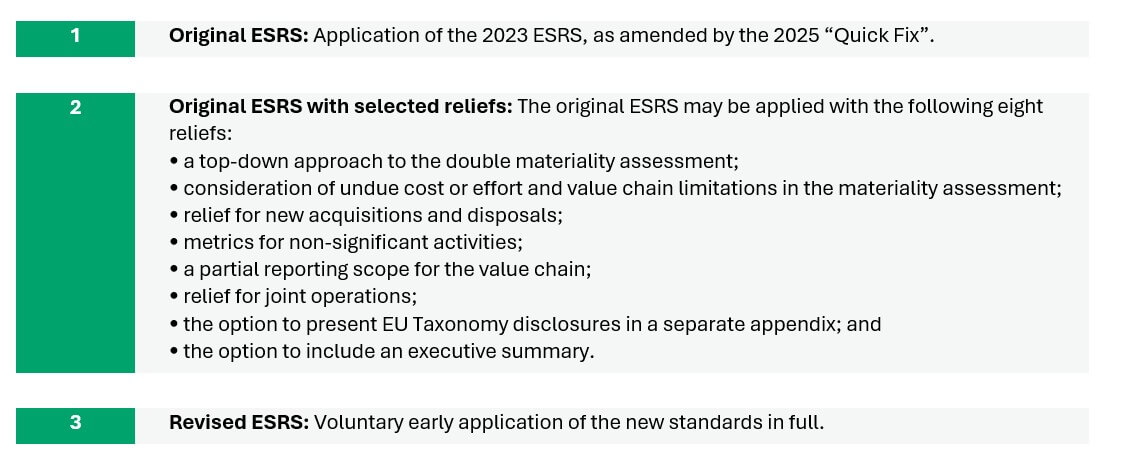
- Transition for 2026: The final Regulation now addresses the period before mandatory application of the revised standards. It allows undertakings to continue using the original ESRS, apply selected reliefs introduced by the revision, or voluntarily apply the new standards early in full.
- Legal effect and application date: EFRAG’s draft technical advice has become a directly applicable EU legal act. The final Regulation establishes when the revised ESRS enter into force and requires their application for financial years beginning on or after 1 January 2027.
Transitional arrangements for financial years beginning in 2026
Undertakings may choose one of three approaches:
What does this mean in practice?
Compared with the draft discussed in last year’s article, the final ESRS have not changed significantly in their main features. The final text confirms the original direction of the revision: a substantial reduction in the number of datapoints, more rigorous application of materiality, an explicit option to use a top-down approach to the double materiality assessment, greater flexibility in the structure of the sustainability statement and simpler treatment of value chain information.
The most fundamental change from the 2023 ESRS therefore remains the shift away from mechanically applying extensive disclosure checklists towards reporting focused on genuinely material information, while retaining double materiality and the requirement for the sustainability statement, taken as a whole, to achieve fair presentation. A smaller number of datapoints will not, however, necessarily result in an equivalent reduction in workload: undertakings will need to adjust their processes, data maps and controls and provide persuasive support for their materiality conclusions. For financial years beginning in 2026, they will also need to select one of the three transitional options in good time and clearly state in the sustainability statement which option they apply.
Sources and further reading